
Specialized Bosch Appliance Repair in San Francisco
Mon–Sat: 8:00 AM – 7:00 PM
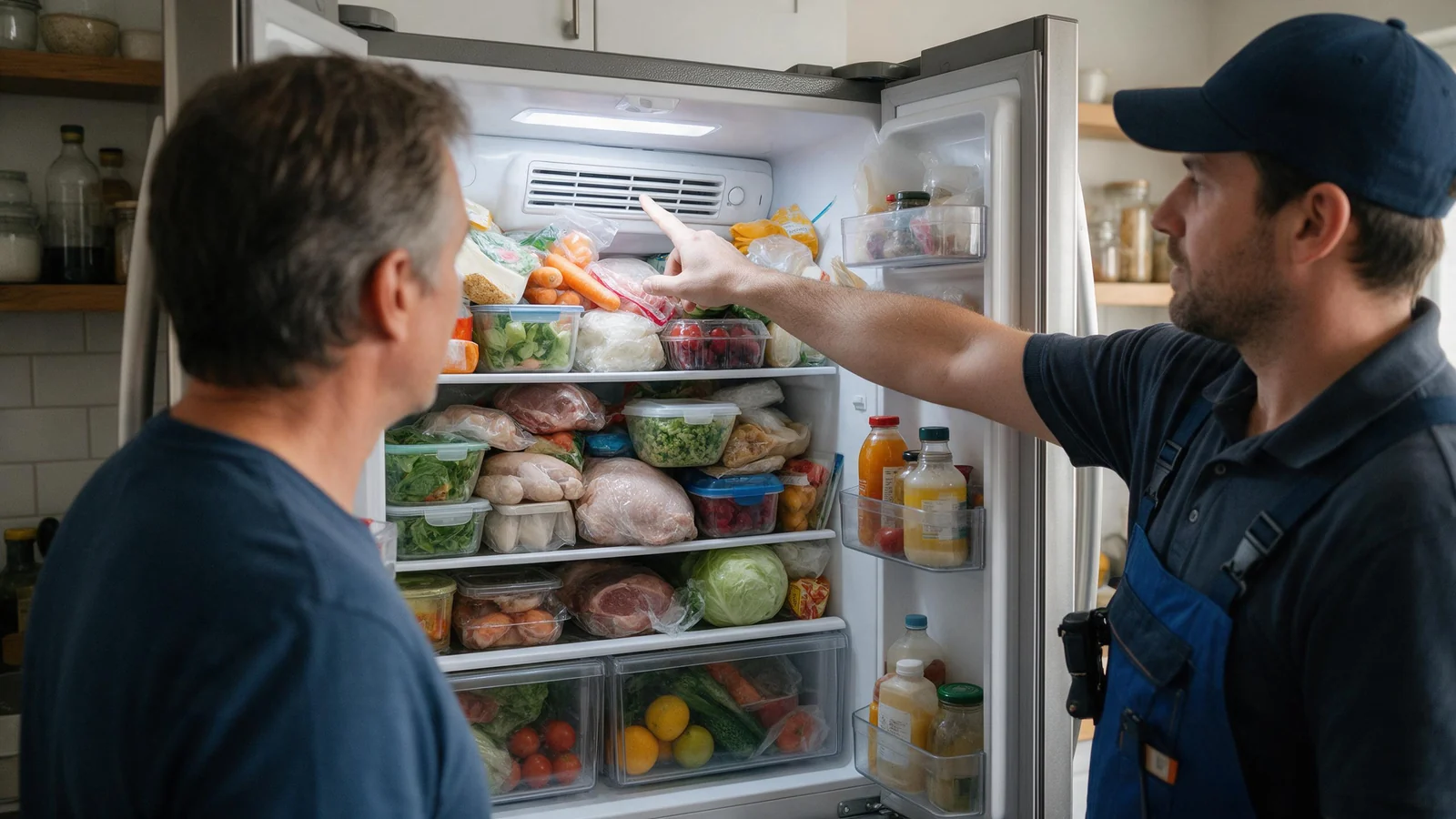
Temperature differences inside a Bosch refrigerator are easier to diagnose when you map where the cabinet is warm instead of calling the whole unit “not cooling.”
The refrigerator is running and some food is clearly cold, yet the upper shelves feel warmer than expected. That pattern matters because it is different from a refrigerator that has lost cooling everywhere. Start by mapping the temperature problem by compartment and shelf level before changing multiple settings.
The goal is not to turn an error symptom into a parts guess. A useful troubleshooting process preserves the exact model information, limits checks to accessible owner-level items, and records what changes before and after each safe step. That creates better information for a repair decision and reduces the chance of hiding the original symptom.
Cold air must move through the cabinet and return through the designed air path. Loading, blocked vents, a door that does not seal consistently, frost, a fan condition, or a model-specific airflow fault can change that circulation. The exact layout varies by Bosch refrigerator family, so the E-Nr is important before assuming where the air should enter or return.
Bosch appliance families can share a brand name while using different controls, sensors, pumps, fans, heaters, water systems, or installation requirements. Always use the complete model/E-Nr when matching a symptom to owner documentation, an error-code page, or a service record.
Before resetting the appliance or changing several settings at once, capture the details that make this complaint reproducible:
A short photo, video, temperature reading, cycle-stage note, or description of what changes with the door, load, program, or setting can be more useful than a long list of parts someone thinks might be bad.
Keep these checks external and reversible, and use the exact owner instructions where the model provides a maintenance procedure:
If one of these checks changes the symptom, record exactly what changed. Avoid making several adjustments at the same time; a controlled comparison is easier to interpret than a moving target.
The following steps cross the line from useful homeowner observation into unnecessary risk or can erase diagnostic evidence:
Also stop using the appliance if you encounter smoke, sparking, a burning or electrical odor, active water near electrical components, gas odor, severe overheating, or a protective device that repeatedly trips. Safety conditions take priority over completing a cycle.
Professional diagnosis becomes the sensible next step when the external conditions are normal but the pattern continues. Examples for this symptom include:
At that point, the job is to test the system indicated by the symptom and the exact model—not to replace the most obvious or expensive component on speculation.
For a San Francisco-area service request, prepare the full model/E-Nr, the exact symptom or code, when it occurs, which safe checks were completed, and the service ZIP code. Location references are intentionally light in these technical articles because the repair guidance should remain useful regardless of neighborhood; ZIP code is used to confirm actual coverage and scheduling.
Yes. Restricted cabinet airflow can create uneven temperatures, although repeated uneven cooling can also have internal causes that require diagnosis.
Not as the first step. A much lower setting can hide the pattern without explaining why one area is warmer. Measure and record first.
No. Loading, door sealing, frost, airflow restrictions, sensing, controls, and fan operation can all matter.
Provide the full model/E-Nr, measured temperatures from the affected areas, any frost or noise observations, and your ZIP code.
If the problem described in this guide continues after the safe external checks, request Bosch refrigerator diagnosis in the San Francisco service area. Include the complete model/E-Nr, the symptom history, any displayed code, and your ZIP code.
Share a few details and we’ll confirm an appointment. Prefer to talk? Call us and we’ll help right away.
This is not an official Bosch service center.
Fields marked with * are required.