

Specialized Bosch Appliance Repair in San Francisco
Mon–Sat: 8:00 AM – 7:00 PM
Bosch washer drains slowly but empties? Time the water removal, check the hose and pump area, and learn when to call a technician.
Slow draining that still finishes usually means partial resistance in the pump path: lint or a small item in the pump, a drain hose that is pinched or set too low, or suds that slow the water down. Time how long the water takes to leave and note where it is slowest before you change anything.
A washer that eventually empties is easy to ignore, and that is the reason to measure it. Slow draining tends to get worse in steps, and the first complete failure usually arrives in the middle of a full load with the door locked. A few minutes of observation now tells a technician far more than a report that it is slow.
Run a short rinse and spin cycle with a small load, and watch the glass at the end of the rinse. Note whether the water level falls steadily, falls and then stalls, or sits for a while before it starts to go down. A pump that runs but moves little water sounds different from a pump that hums and does not move at all, so listen as well as watch. If you can, repeat the test with an empty drum so the load size is not part of the answer.
A slow start followed by a normal rate points toward the hose or the standpipe, because water has to push through a restriction before it flows freely. A steady but weak flow all the way through points more toward the pump or a partly blocked pump filter. Suds are the third possibility: if the drum shows foam at the end of the cycle, too much detergent or non-HE detergent is the likelier cause than any hardware fault.
Bosch lists E:00-18 as a blocked drain pump, and gives two checks: clean the washer drain hose and drain pipe, and perform pump maintenance to clear the blockage. Our Bosch Washer E:00-18 Error Code page goes through it. For E18 the meaning is a drainage hose that is blocked or kinked, and the checks are to confirm the hose is installed without kinks, clean it and the siphon spigot, and clean the drain pump.
Not every slow drain produces a code. A washer can pump out slowly for weeks before the control decides that something is wrong, which is why a code is a late signal and not the first one. If one of these codes does appear, it confirms the direction of travel but still does not say whether the blockage is in the hose, the standpipe or the pump.
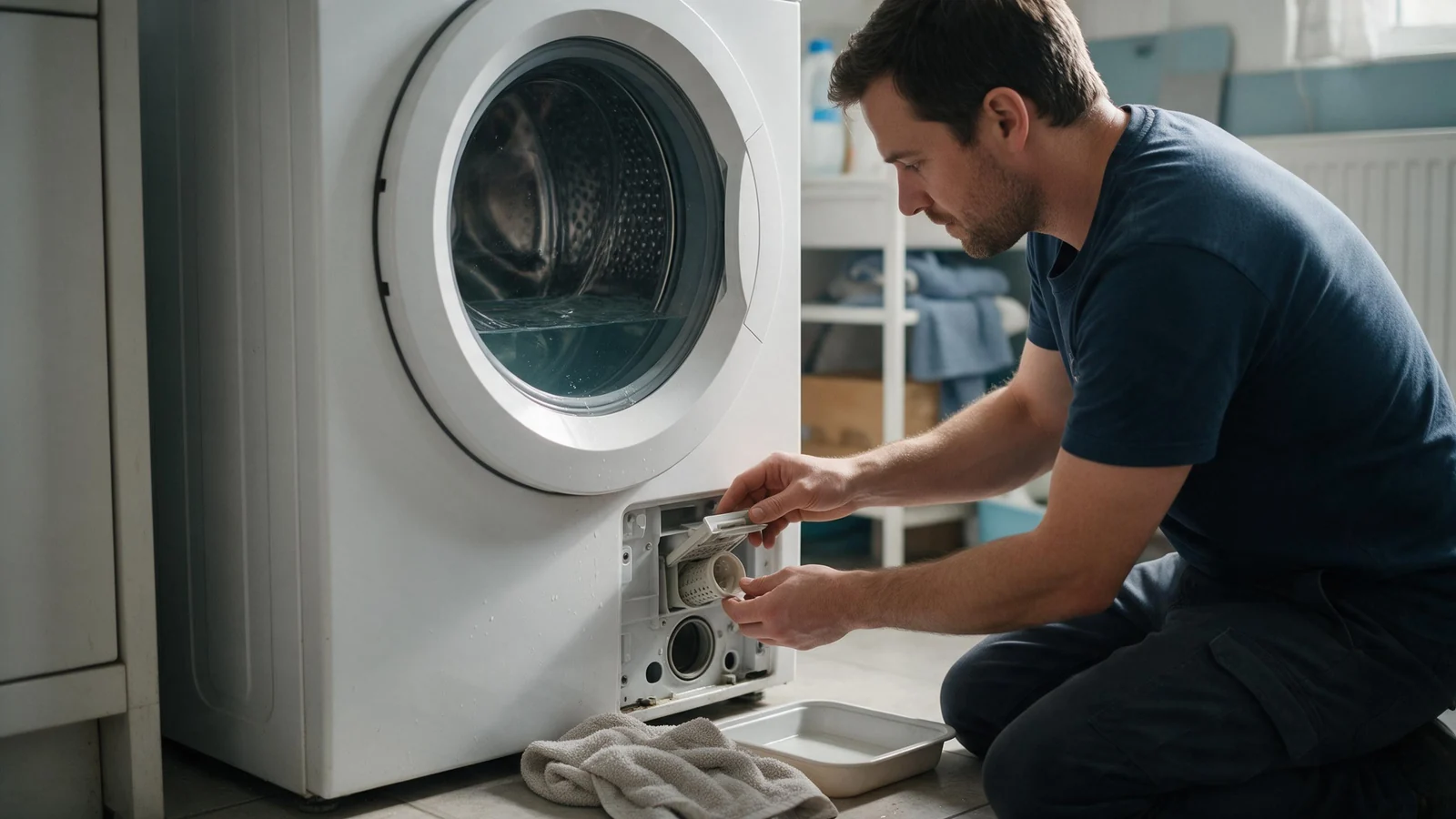
Water will come out when you open the pump filter area, so lay towels down and have a shallow container ready. If your model has a pump filter behind a small door at the bottom front, only open it with the drum empty and the power off.
Different Bosch washers will behave differently at the end of a spin. The WAS24460UC lists a maximum spin speed of 1,200 rpm, while the WGB24600UC is listed with a 1,600 rpm top spin. A faster final spin pushes the last water out harder, so a weak pump on a high-spin model may show up as damp clothes at the end of a cycle before it shows up as a slow drain.
Installation counts too. A hose set too low can let water siphon through before the pump has finished, while a hose set too high makes the pump work harder. Bosch states the correct height in the installation instructions for each model, so check the drain hose against your own manual instead of a general rule.
Cleaning the hose and the pump filter will fix a simple blockage, and that is a good outcome. The checks cannot tell you whether the pump motor is weakening, whether the pump impeller is damaged, or whether the control is reading the water level correctly. A pump that has been working against a blockage for a long time can also be worn by it, so the drain can stay slow even after the blockage has been removed.
A technician will run the drain with the washer open to the pump path, check the pump filter and hoses for blockage, and test whether the pump itself runs and moves water at a normal rate. They will also look at the drain standpipe or the connection to the house plumbing, since the washer cannot drain faster than the pipe allows. You can read what a washer visit covers on our Bosch washer repair page.
Give us the model and serial from the rating label, how long the pump-out takes compared with before, whether any E: code appeared and when, and whether the slow drain happens on every program or only some. Tell us what detergent you use, and mention any recent change to the plumbing or the position of the washer.
For a short time, yes, but it tends to get worse. Avoid large loads and stay nearby the first time you run a cycle after a change, because a full failure can leave the door locked with water inside.
Yes. Bosch ties E:18 to too much detergent or non-HE detergent, and suds slow the removal of water. Use the amount stated for your model and HE detergent only.
It fixes a blocked filter, which is common. If the drain stays slow afterward, the problem is further down the path, in the hose, the standpipe or the pump itself, and a technician should check it.
Share a few details and we’ll confirm an appointment. Prefer to talk? Call us and we’ll help right away.