

Specialized Bosch Appliance Repair in San Francisco
Mon–Sat: 8:00 AM – 7:00 PM
An oven fan that keeps running after you switch off may just be cooling the electronics. Know what is normal and what is not.
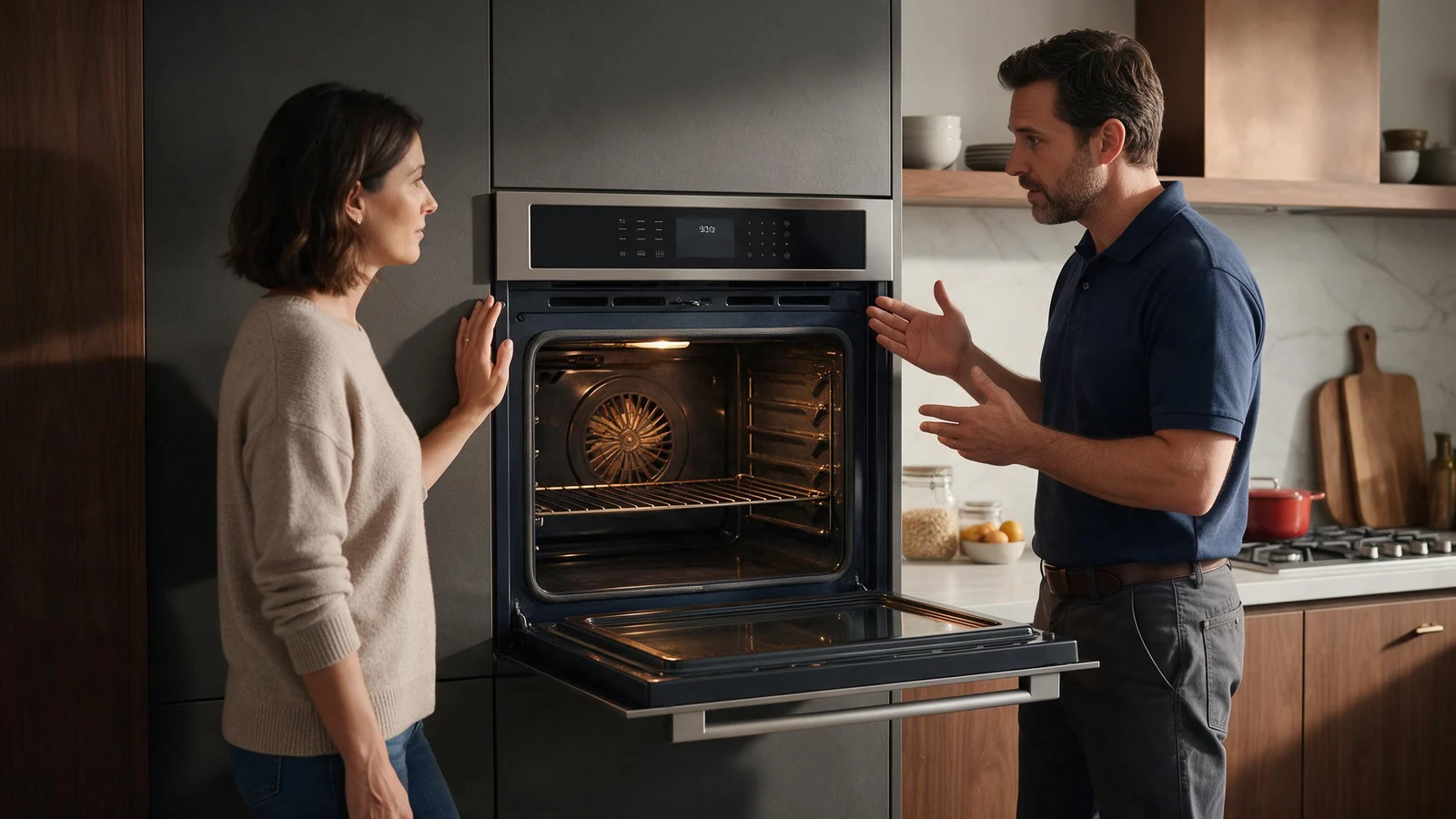
A Bosch oven fan that keeps running after the oven has been switched off is, in most cases, cooling the electronics and cabinet, which is normal design behavior. It becomes a concern only when the fan never stops, runs while the oven is stone cold, is unusually loud, or comes with a code or a burning smell.
Ovens carry electronics close to a hot cavity. After you finish cooking, the fan keeps moving air through the control area so the board and surrounding parts shed heat, then stops when a sensor says the temperature is back in range. That means a long, hot cook leaves the fan running longer than a short one. If the run-on time tracks how hot and how long you cooked, the oven is doing what it should.
It is the pattern that matters. Note how long the fan runs after a short bake and after a long roast. A fan that runs for about the same time whatever you cooked deserves a closer look, as does one that never stops.
Bosch’s list for cooktops and ranges includes heat-protection messages that explain why a cooling fan may be working hard. F2, and its companion F4, mean that the electronics overheated; F2 switches off the corresponding zone and F4 switches off all zones. The listed step is to wait for cooling and then touch any control. If your range shows F4 and the fan is still blowing, the fan is doing its job. Wait, then try again. If the code keeps returning, the unit is not shedding heat as it should, which can be a ventilation or fan fault.
Cooling needs space. A range pushed against a wall, a wall oven boxed into a tight cabinet, or vents covered by a shelf liner can all make the fan run longer. The HBLP651UC, a Benchmark 30-inch double wall oven, lists an overall width of 29 3/4 inches and a height of 52 1/16 inches, so the cabinet around it has to allow for that and for air to escape. For a freestanding model such as the HDS8057U, an 800 Series 30-inch dual fuel range listed at 29 15/16 inches wide and 36 inches high, check that the gap at the sides and back is clear.
Do not remove the back panel or the oven’s vent cover. They lead directly to wiring and hot parts.
For a week, jot down each cook: what you baked, roughly how long, whether you used the self-clean or a high setting, and how long the fan kept going afterward. Two or three entries are often enough to show whether the fan follows the heat or runs by its own rules. Add any day when the fan started without the oven being used. A short, honest log is worth more to a technician than a long description from memory, because it separates a fan that is simply working hard from one that is mis-controlled.
A fan that runs for hours when the oven has not been used, or one that starts on its own, no longer looks like normal cooling. That points to a control reading a sensor wrongly, a stuck relay, or a fan wired to run continuously. Each of those is a board or wiring matter. If the fan runs with the oven cold and you can smell something warm or electrical, switch off at the breaker and call.
The range supply matters too. Bosch lists U400 as supply voltage incorrect, outside the normal operating range, with the step of contacting your electrical utility provider. Erratic power can leave a control behaving oddly, including with its fan.
We watch a full cooking and cooling cycle, check whether the fan speed follows the temperature, inspect the fan and its wiring, check the sensors that tell the control when to stop, and read stored faults. You can see what we cover on our oven repair page and on the oven information page. Have these ready when you call: the model and serial number from the rating label, how long the fan runs after a short and a long cook, any noise and when you hear it, any code, and whether the oven or cabinet has been changed lately.
Yes, usually. The fan cools the electronics and the cabinet, and it should stop once things are cool. A hotter, longer cook means a longer run-on.
A fan that runs for hours with a cold oven is not normal cooling. Switch off at the breaker if there is any smell, and book a check with a note of when it started.
Not always, but a new rattle or whine is worth reporting. Tell us when the noise starts and whether it changes with speed.
Share a few details and we’ll confirm an appointment. Prefer to talk? Call us and we’ll help right away.