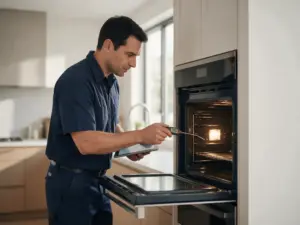
Source: Appliance Helpers - Bosch Range Error Codes
Bosch range F33 is linked with warming-drawer temperature-sensor open circuit. Review the visible symptoms, model details, and safe external checks before deciding on the next step.
A Bosch range showing F33 has detected a condition tied to warming-drawer temperature-sensor open circuit. The code helps narrow the system involved, but it does not by itself prove which component has failed.
At a glance
| Code | F33 |
|---|---|
| Appliance | Range |
| What it means | A Bosch range showing F33 has detected a condition tied to warming-drawer temperature-sensor open circuit. The code helps narrow the system involved, but it does not by itself prove which component has failed.Treat the warning as evidence, not a complete |
Treat the warning as evidence, not a complete repair instruction. Do not bypass interlocks, leak protection, electrical safeguards, or sealed systems just to clear the display. The control uses the drawer sensor to judge drawer temperature, separately from the oven. If that reading is lost, it cannot regulate the drawer.
At a glance
- Code: F33
- Appliance: Bosch Range
- Verified meaning: warming-drawer temperature-sensor open circuit
- Primary diagnostic direction: the heating and temperature-control system
- Service-area context: San Francisco; confirm coverage by ZIP code
Technical meaning of the code
F33 means warming-drawer temperature-sensor open circuit. The warning narrows the diagnostic path toward the heating and temperature-control system, while the exact model and symptom sequence determine how that information should be applied.
F33 relates to the drawer sensor only; F34 is its short-circuit counterpart. Telling them apart helps diagnosis because they suggest different electrical conditions in the same circuit.
What you may notice
Before changing settings or cycling power, record the behavior you can see or hear:
- The control may receive an impossible or missing reading.
- Temperature or cycle behavior may become inconsistent.
- The appliance might stop a program as a protective response.
- The same code may reappear immediately after startup.
Systems and conditions to consider
Diagnosis may need to consider the following possibilities without treating any single one as confirmed:
- A failed sensor or probe.
- Damaged sensor wiring.
- A loose or corroded connector.
- An electronic input fault on the control board.
- A break in the warming-drawer sensor circuit.
Checks to make before service
- Write down the full code and model number.
- Verify only external conditions that can affect the reading, such as a properly closed door or unobstructed user-accessible area.
- Avoid probe internal sensor circuits while the appliance is energized.
These checks are for information gathering only. Do not expose live wiring, bypass an interlock, defeat leak protection, open a sealed refrigeration circuit, or use undocumented service-mode procedures.
Leave the appliance off if
Stop for overheating, electrical damage, gas odor, or water near electrical parts; otherwise avoid repeated operation if the sensor is required for safe temperature control.
If the warning returns
If F33 remains active or comes back after the permitted external checks, the next step is model-specific testing of the system associated with warming-drawer temperature-sensor open circuit. Repeated resets or parts guessing do not identify the actual failure path.
For a service request, include what the appliance was doing immediately before the warning and which safe checks were already completed.
Why the full Bosch model/E-Nr matters
Record the complete model/E-Nr with F33. That identifier helps separate platforms that may use different controls, sensors, or service logic. The E-Nr shows how this range’s drawer sensor is connected, which matters when the drawer and oven share a control.
FAQ
For this record, F33 is associated with warming-drawer temperature-sensor open circuit. The exact model/E-Nr still matters because Bosch can use different hardware and diagnostic logic across product families.
Only if no safety stop condition is present and the appliance is otherwise operating safely. If the warning repeats, performance is abnormal, or there is leaking, smoke, electrical odor, sparking, overheating, or repeated breaker trips, leave the appliance off.
Use only a normal reset that Bosch documents for the exact model. If the warning returns, repeated resets are not a substitute for diagnosis.
No. The code identifies a detected system condition. Model information, symptoms, and model-specific testing are still needed before a component is selected.
Have the full Bosch model/E-Nr, the exact F33 display, the cycle stage or operating state where it appears, the visible symptoms, and the external checks already completed.
Bosch service in the San Francisco area
Ready to have F33 checked?
If F33 remains active or comes back, request Bosch range diagnosis for the San Francisco service area. Include the complete model/E-Nr, exact code, symptom summary, and ZIP code so service coverage can be confirmed.