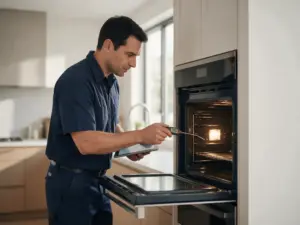
Source: Appliance Helpers - Bosch Range Error Codes
Bosch oven F31 is associated with upper or single-oven temperature-sensor open/short fault. Review symptoms, model details, and safe external checks before deciding on the next step.
When a Bosch oven displays F31, the control has registered upper or single-oven temperature-sensor open/short fault. That narrows attention toward the heating and temperature-control system, but the model/E-Nr and visible symptoms are still necessary before the warning is treated as a parts diagnosis.
At a glance
| Code | F31 |
|---|---|
| Appliance | Oven |
| What it means | When a Bosch oven displays F31, the control has registered upper or single-oven temperature-sensor open/short fault. That narrows attention toward the heating and temperature-control system, but the model/E-Nr and visible symptoms are still necessary before the warning is treated as |
The guidance below remains at the owner-safe level. It focuses on recording the condition and checking accessible items without opening protected electrical, water, gas, refrigeration, or mechanical systems. An open or short fault covers two opposite signal conditions, a broken path and a collapsed one, so the display does not say which occurred.
At a glance
- Code: F31
- Appliance: Bosch Oven
- Verified meaning: upper or single-oven temperature-sensor open/short fault
- Primary diagnostic direction: the heating and temperature-control system
- Service-area context: San Francisco; confirm coverage by ZIP code
What the warning means
F31 means upper or single-oven temperature-sensor open/short fault. The warning points the diagnostic path toward the heating and temperature-control system, while the exact model and symptom pattern determine how that information should be applied.
Symptoms worth recording
Before changing settings or cycling power, note the behavior you can see or hear:
- The control may receive an impossible or missing reading.
- Temperature or cycle behavior might become inconsistent.
- The appliance may stop a program as a protective response.
- The same code can return immediately after startup.
Possible causes
Diagnosis may need to consider the following possibilities without treating any single one as confirmed:
- A failed sensor or probe.
- Damaged sensor wiring.
- A loose or corroded connector.
- An electronic input fault on the control board.
First steps that stay outside the appliance
- Write down the full code and model number.
- Verify only external conditions that can affect the reading, such as a properly closed door or unobstructed user-accessible area.
- Avoid probe internal sensor circuits while the appliance is energized.
These checks are intended to gather useful information without exposing live wiring, bypassing an interlock, defeating a leak-protection device, opening a sealed system, or using undocumented service modes.
When to stop using the appliance
Stop for overheating, electrical damage, gas odor, or water near electrical parts; otherwise avoid repeated operation if the sensor is required for safe temperature control.
When diagnosis becomes the next step
The sensor, wiring, connector path, and control input must be tested against the documentation for the exact model before a part is selected. A displayed code is evidence, not a parts order. The next step is to confirm the reported system against the model and the symptoms present during operation.
For a service request, include what the appliance was doing immediately before the warning and which external checks were already completed.
This code concerns the temperature sensor for the upper or single oven. The control reads that sensor to know cavity temperature, so an unreadable signal can keep it from regulating heat properly. The sensor, its wiring, and the input are separate links in that path.
Why the full Bosch model/E-Nr matters
Have the complete model/E-Nr with F31. That identifier helps separate platforms that may use different controls, sensors, or service logic. Sensor type and connector layout differ across models, so the model number decides how F31 is tested.
FAQ
For this record, F31 is associated with upper or single-oven temperature-sensor open/short fault. The exact model/E-Nr still matters because Bosch can use different hardware and diagnostic logic across product families.
Only if no safety stop condition is present and the appliance is otherwise operating safely. If the code repeats, performance is abnormal, or there is leaking, smoke, electrical odor, sparking, overheating, or repeated breaker trips, leave the appliance off.
Use only a normal reset that Bosch documents for the exact model. If the warning returns, repeated resets are not a substitute for diagnosis.
No. The code identifies a detected system condition. Model information, symptoms, and model-specific testing are still needed before a component is selected.
Have the full Bosch model/E-Nr, the exact F31 display, the cycle stage or operating state where it appears, the visible symptoms, and the external checks already completed.
Bosch service in the San Francisco area
Still seeing F31 on your Bosch oven?
If F31 remains active or comes back, request Bosch oven diagnosis for the San Francisco service area. Include the complete model/E-Nr, exact code, symptom summary, and ZIP code so service coverage can be confirmed. Say whether the oven failed at preheat or later.