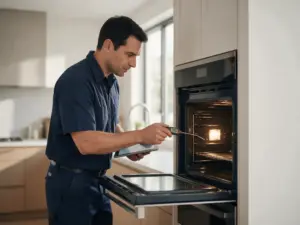
Source: Appliance Helpers - Bosch Range Error Codes
Bosch range F151 is linked with eEPROM failure or communication-circuit fault. Review the visible symptoms, model details, and safe external checks before deciding on the next step.
Bosch range code F151 is associated with eEPROM failure or communication-circuit fault. Treat the display as a diagnostic clue rather than a final parts diagnosis, and preserve the full model number with the code.
At a glance
| Code | F151 |
|---|---|
| Appliance | Range |
| What it means | Bosch range code F151 is associated with eEPROM failure or communication-circuit fault. Treat the display as a diagnostic clue rather than a final parts diagnosis, and preserve the full model number with the code.Start with external observations and manufacturer-approved owner |
Start with external observations and manufacturer-approved owner checks only. If the code persists, move to model-specific diagnosis rather than repeated resets or speculative part replacement. Communication-circuit faults involve modules passing data to each other, not a single moving part.
At a glance
- Code: F151
- Appliance: Bosch Range
- Verified meaning: eEPROM failure or communication-circuit fault
- Primary diagnostic direction: communication between electronic modules
- Service-area context: San Francisco; confirm coverage by ZIP code
How to interpret the display
F151 means eEPROM failure or communication-circuit fault. The warning narrows the diagnostic path toward communication between electronic modules, while the exact model and symptom sequence determine how that information should be applied.
F151 combines two ideas: the stored-memory chip and the circuit that carries data. A problem with either can leave the control unsure of its settings, so the display names a direction rather than a failed part.
Operating behavior that adds context
Before changing settings or cycling power, record the behavior you can see or hear:
- The display may restart, freeze, or respond inconsistently.
- A program can stop without completing.
- Connected functions may become unavailable.
- The code can return shortly after power is restored.
Where diagnosis may need to look
Diagnosis may need to consider the following possibilities without treating any single one as confirmed:
- A loose or damaged communication connection.
- Loss of power to one electronic module.
- A failed interface or control board.
- Software or configuration data that does not match the hardware.
- A data link between control modules interrupted or unreliable.
Safe owner-level checks
- Photograph the exact code before a reset.
- Where the manufacturer permits it, perform one normal power cycle with no sign of electrical damage.
- Avoid open the console or reseat internal connectors while the appliance is energized.
These checks are for information gathering only. Do not expose live wiring, bypass an interlock, defeat leak protection, open a sealed refrigeration circuit, or use undocumented service-mode procedures.
Safety stop conditions
Leave the appliance off for smoke, sparking, burning odor, or a breaker that trips again.
What a service visit needs to determine
A persistent communication warning requires checking module power, data wiring, configuration, and the connected boards for the exact platform. If the warning is intermittent, note the program, temperature, load, or operating stage that makes it return. That pattern can narrow diagnosis considerably.
For a service request, include what the appliance was doing immediately before the warning and which safe checks were already completed.
Why the full Bosch model/E-Nr matters
Record the complete model/E-Nr with F151. That identifier helps separate platforms that may use different controls, sensors, or service logic. The E-Nr tells us which modules this range uses and how they communicate.
FAQ
For this record, F151 is associated with eEPROM failure or communication-circuit fault. The exact model/E-Nr still matters because Bosch can use different hardware and diagnostic logic across product families.
Only if no safety stop condition is present and the appliance is otherwise operating safely. If the warning repeats, performance is abnormal, or there is leaking, smoke, electrical odor, sparking, overheating, or repeated breaker trips, leave the appliance off.
Use only a normal reset that Bosch documents for the exact model. If the warning returns, repeated resets are not a substitute for diagnosis.
No. The code identifies a detected system condition. Model information, symptoms, and model-specific testing are still needed before a component is selected.
Have the full Bosch model/E-Nr, the exact F151 display, the cycle stage or operating state where it appears, the visible symptoms, and the external checks already completed.
Bosch service in the San Francisco area
Does code F151 keep coming back?
If F151 remains active or comes back, request Bosch range diagnosis for the San Francisco service area. Include the complete model/E-Nr, exact code, symptom summary, and ZIP code so service coverage can be confirmed.