

Specialized Bosch Appliance Repair in San Francisco
Mon–Sat: 8:00 AM – 7:00 PM
When induction power drops or pulses on a Bosch cooktop, check pan size, shared power and heat protection before assuming a fault.
When a Bosch induction zone loses power or pulses on and off, the cause is usually cookware that does not suit the zone, a heat-protection step that has kicked in, or power being shared with a neighbouring zone, and only sometimes a failed part. Try a different flat, magnetic pan on a different zone, let the unit cool if it is hot, and note what the display shows when the power drops.
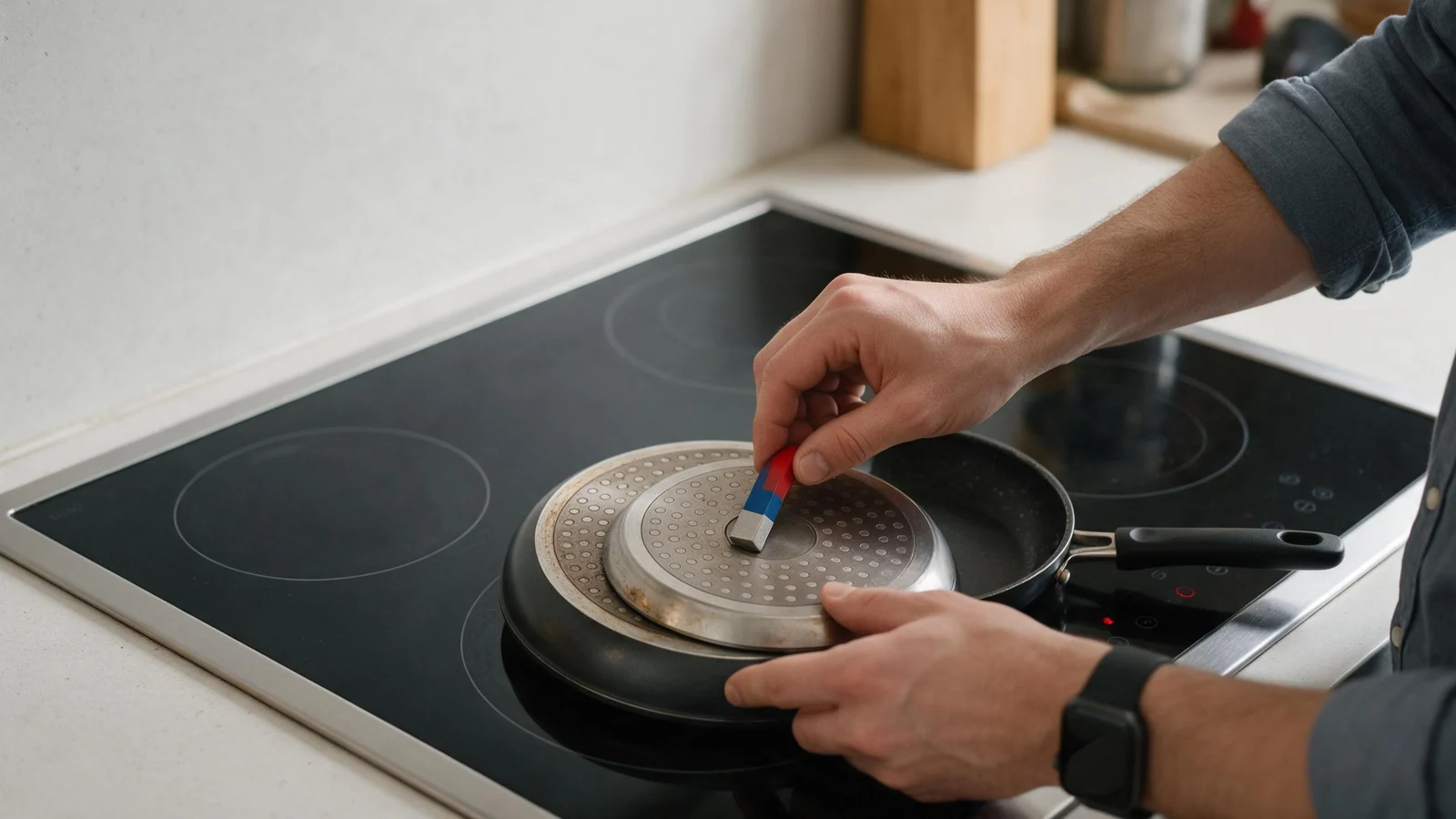
Induction heats the pan itself, so the pan matters more than on any other cooktop type. A base that is warped, much smaller than the zone, or only weakly magnetic will make power flicker or fall. Test it with a magnet: if it grips the underside of the pan firmly, the pan is a fair candidate. Try a second pan that you know has worked, on the same zone, at the same setting. If one pan cycles and the other holds steady, the cooktop is not the problem.
On many induction cooktops, zones draw from shared power, so turning up a second zone or using a boost function can reduce what the first one gets. That can look like a drop in power when it is simply the cooktop balancing its load. The NET8669UC, listed at 37 inches wide and 21 1/4 inches deep with PreciseSelect offering 17 directly selectable cooking levels, has many levels to work with, so a change in one zone can shift what you see in another. Check whether the drop happens only when several zones are running. If it does, that is a clue, not necessarily a defect.
Bosch lists several heat-related codes for its cooktops and ranges. F1 means a cooking zone overheated and switched off to protect the work surface, and the listed step is to wait for the electronics to cool and then switch the zone back on (see the F1 page). F2 and F4 mean the electronics overheated, with F2 switching off the corresponding zone and F4 switching off all zones (see F2 and F4). F5 points to hot cookware near the control panel, and removing the cookware is the listed step (F5 page). F8 means a zone ran too long without interaction and the automatic time limit triggered; you touch any control and set the zone again (F8 page).
| Code | Bosch meaning | First step listed |
|---|---|---|
| F1 | Zone overheated and switched off | Wait for cooling, switch zone back on |
| F2 | Electronics overheated, that zone off | Wait for cooling, touch any control |
| F4 | Electronics overheated, all zones off | Wait for cooling, touch any control |
| F5 | Hot cookware near the control panel | Remove cookware from the panel |
| F8 | Zone ran too long without interaction | Touch any control and set again |
If power loss comes with U400, Bosch lists it as supply voltage incorrect, outside the normal operating range, and the step is to contact your electrical utility provider. For a cooktop connected incorrectly, the listing for E9011 says the appliance is not connected correctly and advises disconnecting from power. Neither is a code to experiment with. If you see either, switch the supply off and call.
A built-in cooktop and a freestanding induction range manage heat differently. The HIS8055U, listed with four induction cooking elements and a 3.9 cu. ft. oven cavity, shares its space with an oven, so cooking at length in the oven while using the zones adds to the heat the electronics must handle. If the power drops late in a long cook and recovers after a rest, heat protection is a plausible reason. Make sure vents are not blocked and nothing is stored against the unit.
Habits can be as important as hardware. Preheating an empty pan on high is a quick way to trigger protection, because the base heats faster than the contents can absorb. Dragging a rough-bottomed pan across the glass can leave the contact uneven. Using a lid that is slightly too big for the pan, or sliding a pan so it sits partly over a neighbouring zone, can also confuse the sensing. If the power drop happens only with one habit, you have found the pattern, and it is worth describing exactly to the technician.
You cannot see the power electronics or measure the supply at the unit. A zone that cycles with every pan, with no code and no heat build-up, may have a failing coil, a cooling fan problem, or a control fault. Those need testing with the cooktop live. Please do not remove the glass or any panel.
We check the supply first, then test each zone with a known pan, read the stored history and examine cooling and connections. Our cooktop repair service and cooktop information page give more detail. Have the model and serial number from the rating label, the zone affected, the pans you tried, the code if any, and how long into cooking the drop occurs.
Often the pan is too small, warped or weakly magnetic, or the cooktop is protecting itself from heat. Try a flat magnetic pan that matches the zone, and let the unit cool.
Not always. F1, F2, F4 and F5 are heat-protection messages that often clear after cooling. If they return quickly, we should look at ventilation and the electronics.
Only pans with a magnetic base. A magnet that grips the underside is a quick test, and a flat base helps the zone work evenly.
Share a few details and we’ll confirm an appointment. Prefer to talk? Call us and we’ll help right away.